
Gym clothes: which fabrics work best for the gym and home workouts
Polyester, elastane, cotton blends, mesh: what each fabric in your gym clothes does, and what to look for when you train at the gym or at home.
By Sport Giese Redaktion ·

For sweaty workouts at the gym, technical polyester, often with a little elastane (spandex), is the most reliable choice: it absorbs hardly any water and moves sweat away quickly. For calmer sessions at home or the trip to the gym, a cotton blend is enough; it feels softer but stays damp for longer. So what decides is not the brand, but how much you sweat and how long you stay in a wet shirt.
This guide explains the common fabrics, what details such as fabric weight or mesh mean, and which pieces from our range are designed for what. There are no workout plans here, only clothing.
Which fabric wicks sweat best?
Usually a polyester technical fabric. According to Öko-Test (a German consumer magazine, in German), polyester textiles absorb hardly any moisture and move sweat and wet away quickly. Cotton, on the other hand, can absorb up to 65 per cent of its own weight in water and releases it only slowly. In training, that means the polyester shirt feels dry again sooner after a set, while the cotton shirt clings. How well a synthetic fabric actually wicks sweat, however, does not depend on the word polyester alone, but on the fibre shape, the knit and the finish of the fabric. A densely knitted polyester shirt without a technical finish can feel much sweatier than a well-made technical T-shirt.
Brands give their technical fabrics their own names, such as Dri-FIT at Nike, dryCELL at PUMA or HeatGear at Under Armour. At heart they mean the same principle: a synthetic yarn that moves moisture away from the skin to the surface, where it evaporates. You can hardly compare the brand names directly in a store; the fabric details on the label are more helpful.
The Nike Pro top is made of 100 % polyester and has mesh panels on the back and sides. The PUMA TAD Essentials T-shirt is made of 160 g/m² single jersey with dryCELL. The Erima TS technical shirt is lighter at around 140 g/m² and made of quick-drying technical polyester.
Technical polyester shirts
 NikeM NP DF NPT SS TOP Mineral Slate/green Strikefrom39,99 €low stock
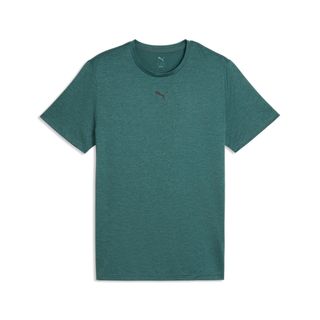 PumaM TAD Essentials Heather CAT T Herb Gardenfrom24,95 €low stock
 ErimaTS shirt function slate greyfrom17,99 €low stock
What does fabric weight (g/m²) mean on sports shirts?
Fabric weight, often written as g/m² or "gsm", tells you how much one square metre of fabric weighs. The lower the number, the thinner and airier the material. Three figures from our range show the spread: the Craft Cool Mesh Superlight base layer weighs 85 g/m², the Erima TS shirt about 140 g/m² and the PUMA TAD Essentials 160 g/m².
- under 100 g/m²: mesh fabric and base layers, very airy, not very opaque
- 130–150 g/m²: a typical technical T-shirt for the gym and sports hall
- from about 160 g/m²: a little denser, hangs more calmly, also wearable as an everyday T-shirt
Mesh means an open, net-like fabric. It usually sits where most heat builds up: on the back, under the arms and at the sides. That is pleasant for classes with a lot of movement, less so in a cool basement at home.
How much elastane do workout leggings need?
For leggings and tights, some elastane is standard, because the fabric has to move with you in squats and stretches and then lie flat again. Besides the fabric, check two things the label does not tell you: is the fabric opaque when you squat, and does the waistband slip when you bend forward?
The PUMA Fit Train Strong 7/8 leggings have a high-rise waistband and dryCELL. The Nike One leggings with a seamless front are squat-proof according to Nike, with a high waistband and a back pocket for your phone. If you are looking for close-fitting tights to wear underneath on cool days, the Jako Long Tight Function is a body-fit tight with flat seams.
Leggings and tights
 PumaPuma FIT Train Strong 7/8 Puttyfrom49,95 €low stock
 NikeNike One Seamless Front Women" SAPPHIRE/WHITEfrom49,99 €low stock
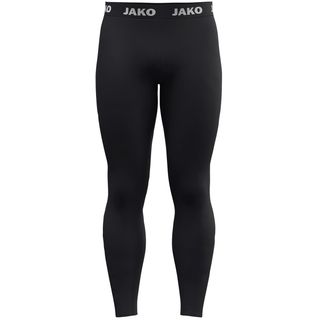 JakoLong Tight Function Blaufrom24,99 €in stock
Is cotton good enough for home workouts?
Yes, if you sweat little and change your T-shirt after the workout. For mobility work, stretching or calm sessions in the living room, the moisture hardly matters, and many people find cotton or a cotton blend more comfortable on the skin. We compare both in detail in technical T-shirt or cotton.
For the trip to the gym, rehab exercise classes or club fitness classes, soft comfort trousers are popular. The Schneider Cambridgew trousers are made of Elastosoft, a fabric developed by Schneider Sportswear itself, with an elastic waistband and drawcord. Schneider describes the Schneider Horgenm trousers, made of the same fabric, as easy-care, shape-retaining and non-shrink, with zipped pockets and an adjustable drawcord at the hem.
Comfort trousers for women and men
 SchneiderCAMBRIDGEW-Hose schwarzfrom64,99 €low stock
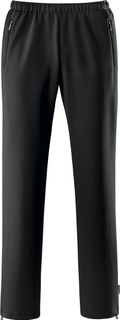 SchneiderHORGENM-Hose schwarzfrom64,99 €low stock
What is different at the gym compared with home?
At the gym it is usually warm, you move between machines and the studio room, and your clothes often stay on for an hour or more. That is where technical fabric, mesh zones and flat seams pay off. At home in an Eifel winter, on the other hand, it is often cooler, especially in a basement or garage. There, long tights or a long-sleeved top make more sense than a tank top.
For women, a well-fitting sports bra is part of the basic kit. How to choose size and support for each sport is explained in sports bras: size and support.
How do technical clothes keep working for longer?
Above all, without fabric conditioner (fabric softener). Stiftung Warentest (Germany's consumer testing foundation, in German) explains that fabric conditioner builds up on the fibres and makes the fabric water-repellent: it no longer absorbs sweat and no longer moves it outwards. More care rules and the meaning of the symbols on the care label are explained in how to wash gym clothes.
Checklist: fabric by activity
- Lots of sweat, classes or strength training at the gym: technical polyester, ideally with mesh zones
- Calm workouts at home, stretching, gentle exercise: cotton blend or comfort fabric
- Cool room or garage in winter: long tights and a long-sleeved top
- Leggings: check that they stay opaque in a squat before you buy
- Read the label: the fabric composition tells you more than the fabric's brand name
- No fabric conditioner for technical clothing