
Football boots for kids: the right size with room to grow
How much room do kids' football boots (soccer cleats) need? 12 mm as a guide value, how to measure, checking every two to three months, cost per season.
By Sport Giese Redaktion ·

As a guide value, a child's football boot (soccer cleat in the US) should be about 12 mm longer on the inside than the foot, measured at the longest toe. More room "to grow into" costs support; less starts to pinch after only a few weeks. Check the fit every two to three months, because children's feet often grow faster than the boot wears out.
The guide value of at least 12 mm comes from children's shoe expert Wieland Kinz in Apotheken Umschau, a German health magazine; depending on the type of shoe and the measuring method, other guides give slightly different figures. The same article advises checking every two to three months whether the shoe still fits. This guide shows how to measure at home, which soleplate suits a first football boot and how to estimate the cost per season.
How much room does a kids' football boot need?
As a guide value, about 12 mm between the longest toe and the tip of the boot, measured inside the shoe, not on the outside of the sole. This space is both room to move and room to grow. How fast children's feet grow is shown by a figure from Apotheken Umschau: for one- to three-year-olds, it is 1.5 mm a month on average. The article gives no figure for older children, so the only answer is to measure regularly.
A football boot fits more closely than an everyday shoe. Nike describes the right fit for children as "snug, not tight". The heel should not slip out when walking or running. A boot that is clearly too big holds the foot less well in turns, and the empty toe gets in the way when touching the ball.
How do I measure my child's feet correctly?
Measure in the evening and with the socks your child wears for training. Nike recommends exactly that, because football socks are thicker than everyday socks. Sometimes that means half a size more.
- Your child stands on a sheet of paper in socks, with weight on both feet.
- Mark the heel and the longest toe. The longest toe is not always the big toe.
- Measure both feet; the longer one counts.
- Add about 12 mm to the foot length: that is a guide value for the inside length of the boot.
- Use this inside length to find the size in the brand's size chart, not the number from the old shoe.
Which soleplate for a first kids' football boot?
For a first football boot, a hybrid soleplate for natural and artificial grass, labelled FG/AG or FG/MG, is the most versatile. Nike describes MG soles as suitable for most surfaces, except indoor courts and concrete. What the individual codes mean is explained in artificial grass: studs or moulded studs?.
The Jako Opura Academy FG/AG is a moulded boot for children, suitable for natural and artificial grass, with a synthetic leather upper and a European last. The Nike Jr. Mercurial Superfly 11 Academy FG/MG is laceless; according to Nike, chevron studs provide traction on artificial and natural grass. The PUMA Future 9 Match FG/AG Jr has an elastic knitted collar and a support band across the midfoot. If your child likes a leather-like feel, the Nike Jr. Tiempo Maestro Academy FG/MG has an upper made of FlyTouch, a synthetic material Nike describes as particularly soft; for grass and artificial grass.
For grass and artificial pitches
 JakoOpura Academy Fg/ag weiß/orangefrom49,99 €in stock
 NikeJR Superfly 11 Academy Fg/mg T Sonstigefrom74,99 €in stock
 PumaFuture 9 Match Fg/ag Jr Glowing Red-puma White-puma BLfrom69,95 €low stock
 NikeJR Tiempo Maestro Academy Fgmg Weißfrom64,99 €low stock
Velcro or laces on the pitch?
For younger children who cannot tie a bow yet, football boots with a Velcro (hook-and-loop) fastening are practical: they can put them on themselves in the changing room. The adidas F50 Messi League FG J has no laces, just a cover with a Velcro fastening. Its soleplate is built for dry natural grass. adidas says the upper adapts to growing children's feet; that does not replace the length guide value. With laces and fixed moulded studs, the PUMA Ultra 7 Play FG/AG Jr is an alternative, with a pull tab at the heel for easier entry.
Easy to put on
 AdidasF50 Messi League LL FG J Ivory/seblbu/iceblufrom75,00 €low stock
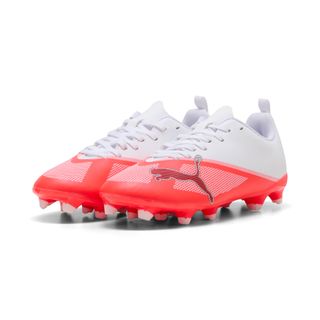 PumaUltra 7 Play Fgag Jr Ultra Red-PUMA Black-PUMA Whitefrom44,95 €low stock
What does a kids' football boot cost per season?
With children, it is usually growth rather than wear that decides how long a pair lasts. Nike puts it plainly: if a child outgrows their boots early, they need to be replaced. So do not calculate in kilometres but in months:
- Formula: purchase price ÷ months the boot fits = cost per month.
- Example A: a pair for €50 that fits for 6 months costs about €8 a month.
- Example B: a pair for €100 that also fits for only 6 months costs about €17 a month.
- A season from August to June is about 10 months. If you buy one pair in autumn and one in spring, you pay about €100 per season in example A and about €200 in example B.
- If indoor shoes for the winter months come on top, calculate the second pair the same way.
These figures are rounded examples, not prices. But they show why an expensive boot on fast-growing feet is mainly just more expensive: it is not worn for longer, it only costs more per month. For teenagers whose feet have nearly stopped growing, the calculation changes, and material and care start to matter. More on that in leather or synthetic. Boots in good condition can be passed on to younger siblings or within the club.
Checklist: does the boot still fit?
- Measure the foot again every two to three months, or have your child stand on the removed insole.
- Toes touch the front or your child is reluctant to put the boots on: measure again.
- Heel slips out when running: boot too big or laced too loosely.
- Check indoor shoes and outdoor boots separately; sizes vary from brand to brand.
- Wear new boots for training first, not straight away in a match.