
Home workouts: basic kit with dumbbells and resistance bands
What you really need to work out at home: a pair of dumbbells, a resistance band, suitable shoes and clothing. With a checklist for your home gym corner.
By Sport Giese Redaktion ·

To get started at home, you need a pair of dumbbells, a resistance band or a set of resistance tubes, sturdy shoes with a flat sole and comfortable clothing. More is not necessary at first, and it all fits in a cupboard. When it gets dark early in the Eifel in November and rain and wind take over outside, a small kit like this is often what keeps you going at all.
This article describes equipment, not exercises or weight recommendations. Which weight and band strength suit you is best discussed with a coach, a fitness instructor or your doctor.
Which dumbbells are good for home workouts?
For the home, coated dumbbells are practical: the core is metal, with a vinyl or neoprene coating on the outside. They do not clank, feel grippy and are less hard on the floor than bare iron. Fixed weights have the advantage that you do not have to change anything. A set with a handle and plates is more flexible, but needs more space and a little assembly.
The Schildkröt vinyl dumbbell set, 2 × 1.0 kg has a cast-iron core and a grippy coating that, according to Schildkröt, resists sweat and scratches and is easy to clean. The V3Tec neoprene dumbbells, 2 × 1.5 kg are the version with a soft neoprene coating. If you want to start with adjustable weights, look at the V3Tec dumbbell set with a total weight of 11 kg. We explain the differences between dumbbell types in detail in dumbbells: neoprene, vinyl or plates.
Dumbbells for home
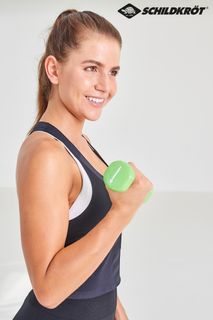 SchildkrötVinyl Hantel Set, 2x 1,0kg (gr Keine Farbefrom17,99 €low stock
 V3TecNOS Neoprenhantel,orange orangefrom22,95 €low stock
 V3TecKurzhantelset 11 kg,schwarz-gr Sonstigefrom39,95 €low stock
Resistance band or tube: what do I need?
A resistance band is a flat rubber band; a resistance tube is a rubber tube, often with handles. Both create resistance as they stretch, weigh almost nothing and fit in any drawer. Many brands show the strength by colour. With the well-known TheraBand, for example, the scale runs from beige through yellow, red, green and blue to black, silver and gold, that is, from 1.1 kg to 9.8 kg of resistance at 100 % stretch (manufacturer data at a retailer, in German). Other brands have their own scales, so colours do not carry over.
With the V3Tec resistance bands, 200 × 7.5 cm and 120 × 7.5 cm, the main difference is length: the long band can be doubled up or looped around a foot, the short one is handier. The Schildkröt expander set contains three tubes with soft handles and different resistance levels: a straight tube of 106 cm, a ring of 65 cm and a cross tube of 95 cm, plus a mesh bag. More on lengths and strengths is in resistance bands: strengths, lengths and uses.
Bands and tubes
- V3TecNOS FITNESSBAND 200 x 7,5 cm,d designfrom13,95 €low stock
 V3TecFITNESSBAND 120 x 7.5 cm desig designfrom10,95 €low stock
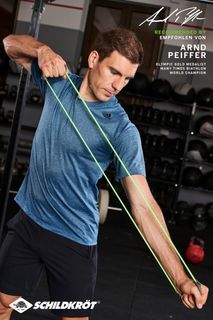 SchildkrötEXPANDER SET (3 Expandertubes) 07from19,99 €low stock
Do I need trainers for working out at home?
Yes, as soon as you do more than stretch, because socks slip on laminate and tiles. For strength exercises, a shoe with a stable, flat sole is a good choice; for jumps and cardio, one with cushioning and lateral support. Whatever shoes you wear, always put dumbbells down in a controlled way. If you wear the shoes only indoors, floors and soles stay clean.
According to Nike, the Nike Flex Train for men and the Nike Flex Train for women have a very flexible rubber outsole with flex grooves, moderate cushioning, an elastic band around the heel and a light mesh upper. Both are in stock in many sizes.
Training shoes for indoors
 INTERSPORTNike Flex Train Braunfrom79,99 €low stock
 INTERSPORTW Nike Flex Train Black/white-anthracitefrom79,99 €low stock
What else do I need?
- A non-slip surface: an exercise mat or a firm rug, so that dumbbells do not land directly on parquet or tiles.
- A towel and a water bottle within reach.
- Clothing that does not restrict you: a cotton T-shirt is enough for calm sessions; if you sweat a lot, choose a technical T-shirt. See technical T-shirt or cotton.
- A fixed place for everything: equipment that does not have to be put away gets used more often.
Ankle and wrist weights such as the Schildkröt weight cuffs, 2 × 0.5 kg are another option: they have a nylon-Lycra cover filled with metal granules and sand, and attach to arms or legs with a Velcro (hook-and-loop) strap. They are an addition, not a replacement for dumbbells.
In what order should I buy home workout equipment?
Start with what you will use most and buy more only after a few weeks. Many people soon find out whether they prefer working with bands or with dumbbells. A sensible order for beginners:
- first shoes and a mat, because you need them in every session
- then a resistance band or tube set, because it takes up little space and is versatile
- after that, a pair of dumbbells in a weight your coach or instructor recommends
- only later a plate set or more weight steps, once you know you will stick with it
That way, you avoid a large set sitting unused in the basement.
How much space do I need?
Less than you might think. What matters is that you do not hit anything with your arms outstretched, that nothing breakable is within reach and that the floor is level. Before training, quickly check bands for tears and, with a plate set, check that all collars are tight. Bands should not be left in strong sun or on the radiator.
Checklist: basic kit for home
- a pair of dumbbells (vinyl or neoprene) or a dumbbell set with plates
- a resistance band or tube set
- training shoes with a flat sole, for indoors only
- an exercise mat or firm rug as a base
- towel, water bottle, spare T-shirt
- before every session: check bands for tears and collars for a tight fit