
Being seen on the bike: colours and reflectors in the dark months
Which bike lights German law (StVZO) requires, why bright colours work by day and reflective details at night, and where reflectors on clothing help most.
By Sport Giese Redaktion ·

In the dark months, two things make you visible on a bike: the lights the law requires on the bike itself, and your clothing. The lights are compulsory; your clothing decides how early a driver recognises you as a person. The Touring Club Schweiz (the Swiss motoring and cycling association) gives guide values from tests: at night, about 25 m of visibility in dark clothing, 40 m in bright or fluorescent colours and 140 m with reflective materials. These are rough figures, not a guarantee for every situation; headlights, weather and surroundings change them.
Which bike lights does the StVZO require?
Section 67 of the StVZO (the German road vehicle regulations) sets out what a bicycle must have in Germany. The essentials in brief:
- At the front, a white headlight that does not dazzle others, and a white reflector. Flashing headlights are not allowed.
- At the back, a red rear light and a red category Z reflector. Flashing rear lights are not allowed either.
- Yellow reflectors on the pedals, facing forwards and backwards.
- On the sides of both wheels: white reflective rings on the tyres or rims, fully reflective spokes or spoke sleeves, or at least two yellow spoke reflectors per wheel.
- The lights may run on a dynamo, batteries or a rechargeable battery. Removable lights are allowed, but must be fitted in the dark or in poor visibility.
You can buy lights and reflectors from a bike shop; in our cycling range we only stock clothing. Lights make you visible as a point of light. Only your clothing shows whether that point is a cyclist and how wide it is.
How much reflective area is enough? Our rule of thumb: spread out so that you can be recognised from every direction. Drivers see you from the front and back when travelling in the same lane, but at junctions and driveways they come from the side. For the side, the StVZO requires reflectors on the wheels; on clothing, reflective details on the sides of your jacket, gilet and trousers are therefore worth having. A single stripe across the back covers only one of four directions.
What helps more: bright colours or reflectors?
Both, at different times. Fluorescent colours such as yellow and orange stand out in daylight and at dusk. At night they only work as a light-coloured surface. Reflective areas, on the other hand, are inconspicuous by day, but at night they bounce headlight beams straight back towards the car. The best choice for autumn and winter is therefore a bright base colour with reflective areas.
The CMP 2-in-1 jacket in fluorescent yellow is windproof and has detachable sleeves. The CMP women's running gilet in fluorescent yellow is windproof, very light and has reflective details; worn over a dark jacket, it turns you into a bright surface. The Clique Willmar is a reflective wind jacket with a hood and zipped pockets, good for everyday riding.
Bright and reflective
 CMPMAN Jacket With Detachable SLE Yellow Fluofrom74,95 €low stock
 CMPWoman Vest Yellow Fluofrom35,95 €low stock
 CliqueWillmar 07from99,95 €low stock
Where do reflectors on clothing make the most difference?
On parts of the body that move. The Touring Club Schweiz describes reflectors on moving body parts, such as the feet and ankles, as considerably more effective. On a bike your feet go round with the pedals, and a reflector that moves up and down catches the eye in headlights more than a stationary one.
The Craft Shelter Bootie, an overshoe (shoe cover), has reflective prints and so sits exactly where you move most. The CMP long cycling tights for men have reflective details and a reflective print on the front. Your hands count too: when you turn, you signal with your arm. The Craft All Weather Glove has design elements that help you be seen in the dark.
Reflectors in motion
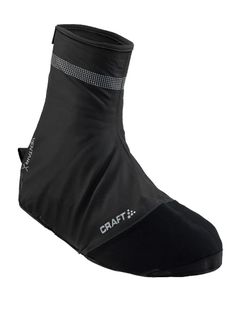 CraftCraft Shelter Bootie Blackfrom49,95 €low stock
 CMPMAN Bike Pant Nerofrom79,95 €low stock
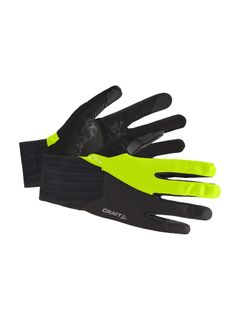 CraftALL Weather Glove Blackfrom44,95 €low stock
Which gilet makes you visible on the bike?
A gilet (wind vest) over your jacket is the simplest way to make a favourite dark jacket visible at night. For cycling it should fit closely so it does not flap in the wind, and be long enough at the back, because traffic behind you sees you from the rear.
The Craft ADV Essence Lumen Wind Vest for men and the women's version have reflective material at the front and sides, a wind- and water-repellent front and mesh on the back. Both pack into a jersey pocket, so you only need to put them on when dusk falls.
Reflective gilets
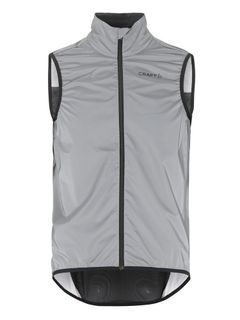 CraftADV Essence Lumen Wind Vest M Silver/blackfrom69,95 €low stock
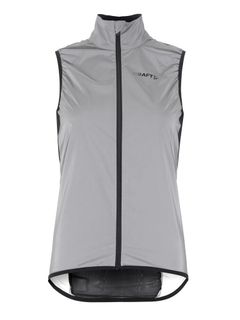 CraftADV Essence Lumen Wind Vest W Silver Reflective/blackfrom69,95 €low stock
What else should you keep in mind?
- A backpack or pannier often covers the reflective areas on your back; in that case the reflector belongs on the bag.
- Treat reflective strips according to the care label: do not wash them hotter than stated and do not iron them if the label rules it out.
- Dirt reduces the effect: after a ride on wet farm tracks, check your overshoes and trouser legs.
- Check your lights before every ride in winter. Lights are compulsory; clothing adds to them but does not replace them.
Similar principles apply to runners, see running visibly in the dark. Which layers to wear underneath in the cold is covered in cycling clothing for autumn and winter. And if children ride with you, you will find tips in cycling with children.
Checklist before riding in the dark
- Headlight and rear light on, not flashing, battery charged.
- Reflectors at the front, back, on the pedals and on the wheels, present and clean.
- Bright outer clothing, or a gilet with reflective areas on top.
- Reflectors on your feet or ankles, where they move with you.
- Back uncovered: reflective areas not hidden by your backpack.