
Gym bags: size, compartments and a shoe compartment
How big a gym bag should be, what bottom compartments, shoe tunnels and wet pockets are for, and when a backpack or drawstring bag is enough.
By Sport Giese Redaktion ·

As an editorial guide value, a bag of around 20 to 40 litres is enough for a trip to the gym: room for shoes, a change of clothes, a towel and a water bottle. More important than the volume is a separate compartment for shoes or wet things, either as a bottom compartment or a side shoe tunnel. If you come straight from work or play indoor sports at a club, choose a bigger bag from about 50 litres.
How big should a gym bag be?
That depends on what you take. A quick tally helps: a pair of training shoes, a T-shirt, shorts or bottoms, socks, a towel and a water bottle fit in a compact bag. Add shower things, a large bath towel, a jacket for an Eifel winter and a change of clothes for afterwards, and it quickly doubles. The following values are our own guide, not manufacturer figures:
- around 20 litres: gym nearby, change there, no shower
- 30 to 45 litres: gym with a shower, shoes and a change of clothes
- from about 50 litres: club, indoor sports, training straight after work, a family sharing one bag
Is a drawstring bag or backpack enough?
For short trips and little luggage, yes. A drawstring bag has no compartments, weighs almost nothing and can be rolled up. A backpack is more comfortable if you cycle or walk to the gym, because the weight sits on both shoulders.
The PUMA Active Training Essentials Small Sportsbag is a compact 20-litre bag measuring 22.5 × 36 × 20 cm, with a water-repellent coating, a side mesh pocket and a zipped front pocket. The PUMA Phase Small Gym Sack is a drawstring bag measuring 35.5 × 41 cm, with a drawcord and a PU-reinforced lining. The Jako Iconic backpack measures 28 × 21 × 46 cm and has a separate 10 cm high bottom compartment that keeps shoes, for example, apart from everything else.
Compact: bag, drawstring bag, backpack
 PumaAT ESS Small Sportsbag Puma Blackfrom39,95 €low stock
 PumaPuma Phase Small Gym Sack Alpine Snow-90ies AOPfrom9,95 €low stock
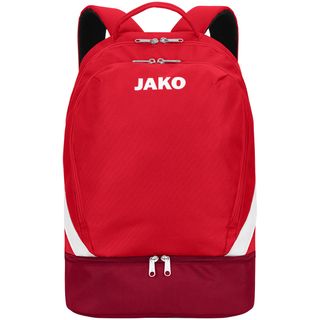 JakoRucksack Iconic Weißfrom29,99 €low stock
What is a bottom compartment for?
A bottom compartment is a separate compartment underneath the main one, with its own zip. Shoes or wet clothes go there, apart from everything else. The main compartment stays clean and dry, and you do not have to unpack everything to get to your shoes.
The Jako Iconic sports bag has a 12 cm high bottom compartment, plus a deep zipped wet compartment on the right and another pocket on the left. Jako offers it in three sizes, from 45 × 24 × 37 cm to 65 × 30 × 44 cm. The Erima Intro sports bag with bottom compartment keeps shoes or wet clothes in the separate bottom compartment and has an inner mesh pocket for a bottle and small items. The Jako One sports bag with bottom compartment also comes in several sizes.
Gym bags with a bottom compartment
 JakoSporttasche Iconic Blaufrom44,99 €low stock
 ErimaIntro sportsbag with bottom ca blackfrom39,99 €low stock
 JakoSporttasche One mit Bodenfach marinefrom29,99 €low stock
Bottom compartment or side shoe tunnel?
Both keep shoes apart from the rest. A bottom compartment holds more, such as shoes and a wet towel together, but makes the bag taller. A side shoe tunnel is quicker to reach and fits one pair of shoes. If you want to keep indoor and outdoor shoes apart, a tunnel plus a wet compartment serves you well.
The PUMA teamGOAL Teambag M holds 55 litres at 65 × 32 × 29 cm, with a U-shaped main compartment, a side compartment with a shoe tunnel, a small front pocket for valuables and a side mesh pocket for the water bottle. The Erima Intro sports bag has a side shoe and wet compartment and a side mesh pocket. Erima gives about 25 litres for size S and about 42 litres for size M.
Gym bags with a shoe compartment
 PumateamGOAL Teambag M Puma Blackfrom44,95 €low stock
 ErimaIntro sportsbag blackfrom29,99 €low stock
Which details are practical in everyday use?
- a zipped outer pocket for keys, membership card and phone
- a side mesh pocket for the water bottle, so it does not leak in the main compartment
- an adjustable, padded shoulder strap if you carry the bag any distance
- water-repellent fabric or a coated base for wet car parks in autumn
- a light-coloured lining or an inner pocket, so small items do not disappear
For the water bottle, it is worth checking the dimensions. The Jako water bottle holds 750 ml, is 7 cm in diameter and 23 cm tall. It has a wide opening for cleaning and, according to Jako, is not suitable for fizzy drinks.
Which bag suits families and clubs?
When several people share one bag, or children go straight from school PE to their club, organisation matters most. Separate compartments for shoes, wet things and valuables save time in the changing room. Large team bags of 50 litres and more are practical if you go by car. If you come by bike or bus, a medium bag or a backpack with a bottom compartment serves you better, because a full large bag hangs heavily from one shoulder.
With bags that come in several sizes, it is worth looking at the dimensions in centimetres rather than just S, M or L. Jako, for example, calls its sizes Bambini, Junior and Senior.
How do I keep my gym bag fresh?
By not leaving wet things in it. In its care guide, Nike advises against leaving damp workout clothes balled up in your bag; hang them up to dry as soon as you get home, because otherwise mould and odour can develop. For the bag itself, that means: unpack it after training, leave it open, and wipe out the bottom and wet compartments now and then. How to wash the clothes afterwards is covered in how to wash gym clothes.
Checklist: what goes in your gym bag?
- training shoes in the shoe compartment, indoor shoes for indoors only
- T-shirt, shorts or leggings, socks, a sports bra if needed
- a towel for the equipment and one for the shower
- water bottle
- a spare T-shirt and a warm layer for the way home
- a bag for wet laundry if there is no wet compartment