
When are running shoes worn out? Kilometres, signs and cost per kilometre
ASICS says 650 to 800 km. How to spot worn-out running shoes, how to count your kilometres and how to work out the cost per kilometre.
By Sport Giese Redaktion ·

Running shoes are worn out when the midsole is visibly compressed, the shoe no longer stands straight or the upper tears. As a guide value, ASICS gives 650 to 800 kilometres; 500 to 800 kilometres is also often quoted. How long a particular pair lasts, however, depends on body weight, surface, running style and model; there is no fixed limit.
How many kilometres do running shoes last?
Manufacturers' figures are guide values, not a guaranteed lifespan. ASICS generally recommends replacing running shoes every 650 to 800 kilometres and points out that heavier runners will probably need to replace theirs sooner.
The surface matters too. Tarmac wears the outsole down evenly, while gravel and forest tracks put more strain on the upper. If you run a lot on wet paths in the Eifel, also pay attention to how well your shoes dry: a pair that always stands damp in the hallway ages faster.
How can you tell your running shoes are worn out?
The number of kilometres is a pointer; the condition is what decides. Check your shoes for these signs every few weeks:
- The midsole looks compressed, with deep creases on the side, and feels soft and spongy.
- Placed on a table, the shoe no longer stands straight but tilts inwards or outwards.
- The mesh in the toe area has tears or holes.
- The outsole tread is worn away at the main pressure points and the midsole shows through.
- The heel counter has gone soft and no longer holds your heel.
- Compared with a new pair of the same model, the shoe feels noticeably flatter.
If you have pain when running, have it checked by a doctor rather than just changing your shoes.
How do you keep track of the kilometres?
Many running watches and running apps let you add shoes as gear and assign the kilometres automatically. Without a watch, a note in your calendar is enough: date of purchase, rough weekly mileage, done. Write the purchase date on the inside of the tongue with a waterproof pen, and you'll see it every time you put the shoes on.
A worked example: if you run about 25 kilometres a week, you'll cover around 1,300 kilometres a year. At 650 to 800 kilometres per pair, that's just under two pairs a year.
How much does a running shoe cost per kilometre?
The formula is simple: price divided by kilometres run. The following figures are rounded examples, not prices from our shop:
- A pair costing €160 that lasts 800 kilometres costs 20 cents per kilometre.
- A pair costing €120 that lasts 600 kilometres also costs 20 cents per kilometre.
- A pair costing €100 that lasts 400 kilometres costs 25 cents per kilometre.
So the purchase price alone tells you little. What counts is how many kilometres you actually run in the shoe and whether it fits you over those kilometres. A shoe that pinches and ends up in the cupboard after 100 kilometres is the most expensive of all.
Calculated per season: if you run about 20 kilometres a week from March to October, roughly 32 weeks, you'll cover about 640 kilometres. At 20 cents per kilometre, that's around €130 in shoe costs for the season, or roughly one pair.
Is a second pair worth it?
Alternating two pairs costs no more per kilometre than one pair: you spread the same kilometres over two pairs and buy replacements correspondingly less often. The advantage lies elsewhere. A pair can dry completely between two runs, and you have the right shoe for different conditions.
In the Eifel, a second pair with a waterproof membrane for rain, mud and snow makes sense. The Brooks Ghost 18 GTX for men and the Brooks Ghost 18 GTX for women are neutral running shoes with a GORE-TEX membrane for dry feet in the wet. If you're often out on forest tracks, the Brooks Divide 6 GTX for women offers GORE-TEX and a TrailTack outsole for road and trail.
A second pair for wet days
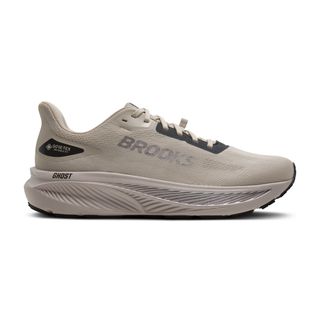 BrooksGhost 18 GTX Chateau/Black/Metallicfrom170,00 €in stock
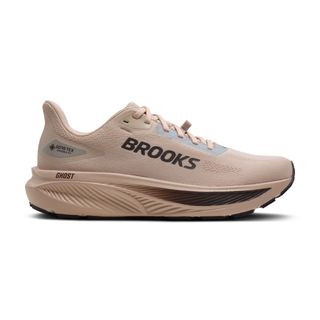 BrooksGhost 18 GTX Rose Dust/Raisinfrom170,00 €low stock
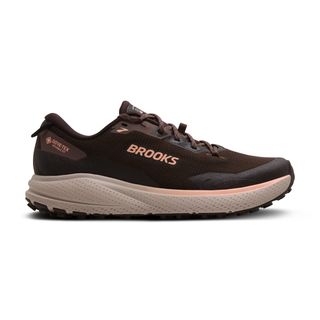 BrooksDivide 6 GTX Coffee Bean/Peppercorn/Rosefrom130,00 €in stock
When should you buy the new pair?
Buy the successor before the old pair is completely worn out. That way you can get to know the new pair on short runs while the old one covers the remaining kilometres. Stick with the proven model if you were happy with it; the next version may feel different, though, so try it on.
For everyday running on tarmac and farm tracks, good options include the Brooks Ghost 18 for women, with a durable outsole for training and longer runs, or the ASICS Gel-Cumulus 28. On the Gel-Cumulus 28, ASICS uses AHAR LO material at the heel, intended to provide traction and durability in high-wear areas.
Everyday successors
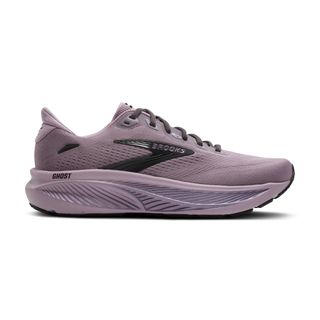 BrooksGhost 18 Elderberry/Blackfrom150,00 €low stock
 AsicsGEL-CUMULUS 28 Beigefrom160,00 €in stock
If you want to change something with your new pair, such as the drop, read Heel-to-toe drop explained first. The basic questions for choosing are in Which running shoes are right for me?.
How can you make running shoes last longer?
- Wear running shoes only for running, not for everyday use or at the gym.
- Stuff wet shoes with newspaper and dry them at room temperature, not on the radiator.
- Undo the laces when taking them off instead of treading the heel down.
Checklist: are my running shoes worn out?
- Add up the kilometres and compare with 650 to 800 km.
- Put the shoe on a table: does it stand straight?
- Look at the midsole from the side: deep creases, soft?
- Check the tread and the mesh.
- Work out the cost per kilometre: price divided by kilometres.
- Buy the successor while the old pair is still running.