
Heel-to-toe drop explained: 0, 5, 8 or 10 mm?
What a running shoe's heel-to-toe drop is, how it's measured and what 0, 6, 8 or 10 mm mean in practice, with examples and manufacturer figures.
By Sport Giese Redaktion ·

Heel-to-toe drop, or simply drop, is the height difference in millimetres between the heel and the forefoot of a running shoe. A shoe with 39 mm of sole under the heel and 33 mm under the forefoot has a 6 mm drop. The models in this article range from 0 mm on a barefoot shoe to 12 mm on a classic everyday shoe. There is no drop that suits everyone.
How is heel-to-toe drop measured?
Manufacturers give two values: the sole thickness, or stack height, at the heel and at the forefoot. The difference is the drop. For the Triumph 20, for example, Saucony gives 37 mm at the heel and 27 mm at the forefoot, so a 10 mm drop.
There are two things you should know. First, the figures refer to one particular size; in other sizes they may differ slightly. Second, independent tests sometimes measure different values from the ones the manufacturer gives. The drop is a good guide but not an exact measurement for your foot.
Important: drop and stack height are two different things. A heavily cushioned shoe can have a low drop, and a thin racing shoe a high one.
Where can you find the drop of your shoe?
The drop is rarely printed on the shoe itself. You'll find it in the retailer's product description or on the manufacturer's website, often listed as drop, heel-to-toe drop or offset. Some manufacturers only give a category: Salomon, for instance, calls values from 8 mm upwards a standard drop. Note the value of your favourite shoe, and you'll have a reference point next time you buy.
What does a 0 mm drop mean?
With 0 mm, heel and forefoot sit at the same height. That says nothing about how thick the sole is: there are zero-drop shoes with thick cushioning as well as barefoot shoes with a very thin sole. The Merrell Trail Glove 8 is such a model: Merrell gives a 0 mm drop and describes it as a minimalist trail shoe. For smaller feet, the same shoe is available as the Merrell Trail Glove 8 in sizes EU 38.5 to 42.5.
0 mm drop
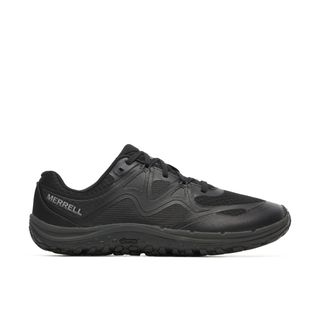 MerrellTrail Glove 8 Blackfrom140,00 €low stock
 MerrellTrail Glove 8 Blackfrom140,00 €low stock
Runners who switch from a high drop to a much lower one usually do so gradually and with advice. If you have pain, have it checked by a doctor.
What does a 4 to 6 mm drop mean?
A low drop of 4 to 6 mm is found on many modern shoes, from training shoes to trail models. The shoe sits flatter, yet the sole is often still well cushioned.
According to adidas, the men's adidas Adizero Evo SL has a 6 mm drop with 39 mm at the heel and 33 mm at the forefoot, and a Lightstrike Pro midsole. The New Balance Fresh Foam X Evoz v3 is a neutral shoe for road and forest tracks, also with 6 mm. Off-road, the Salomon Ultra Glide 2 combines a 6 mm drop with reverse-camber rocker geometry for a smooth roll. The Hoka Speedgoat 7 also falls into this range with 5 mm; more on that in Trail running shoes for the Eifel.
6 mm drop
 Adidasadizero Evo SL M CBLACK/IROMNT/GREFOUfrom150,00 €low stock
 New BalanceMevozlh3 NB Navyfrom130,00 €low stock
 SalomonUltra Glide 2 W Nightshade/Vanilla Ice/Serenityfrom150,00 €low stock
What does an 8 mm drop mean?
8 mm is a middle ground that many manufacturers choose for versatile models. The Brooks Hyperion 2 has an 8 mm drop and, with its DNA Flash v2 cushioning, is designed for tempo runs. The Saucony Guide 15 also has 8 mm, with 35 mm at the heel and 27 mm at the forefoot, and offers light support with Hollow-Tech.
8 mm drop
 BrooksHyperion 2 Illusion/Coral/Blackfrom150,00 €low stock
 SauconyGUIDE 15 Beigefrom150,00 €low stock
What does a 10 to 12 mm drop mean?
A high drop was the standard for running shoes for a long time and is still common on many everyday shoes. The foot sits clearly lower at the front than at the heel.
The Brooks Launch 10 has a 10 mm drop and is a light, versatile shoe for faster runs. The Saucony Triumph 20 has 10 mm, with 37 mm at the heel and 27 mm at the forefoot, a highly cushioned PWRRUN+ sole and rocker-like geometry. The Brooks Trace 3 sits at the top end with 12 mm and relies on soft DNA Loft cushioning with a Segmented Crash Pad at the heel.
10 to 12 mm drop
 BrooksLaunch 10 Blue/Black/Fiery Coralfrom120,00 €low stock
 SauconyTriumph 20 Ocean/coralfrom180,00 €low stock
 BrooksTrace 3 Ebony/Fiery Red/Whitefrom110,00 €low stock
High values exist off-road too: according to Salomon, the Speedcross 6 has a 10 mm drop.
Which drop is right for you?
There is no universally correct drop. More useful than a number is the question of what your body is used to and how the shoe feels when you run.
- You're happy with your current shoe: stay with a similar drop, even if you change brands.
- You want a model with a very different drop: try it on short runs first and keep your old shoe for the rest.
- You run a lot off-road: besides the drop, pay attention to grip and hold, which matter more there.
- You have discomfort: don't change the drop on your own; have it checked by a doctor.
Drop is only one of several criteria. Fit, cushioning and surface count just as much; see Which running shoes are right for me?. If you alternate two pairs with different drops, you also spread the kilometres; more on that in When are running shoes worn out?.
Checklist: heel-to-toe drop when buying shoes
- Look up the drop of your current shoe; it is often on the manufacturer's website.
- Consider drop and stack height separately.
- No big jumps, such as from 10 to 0 mm, without advice.
- When trying shoes on, run a few metres too, don't just stand.
- Treat the figures as guide values, not exact measurements.