
Trail running shoes for the Eifel: mud, roots and wet slate
Which lugs for mud, how much protection from rocks and roots, with or without GORE-TEX: how to choose trail running shoes for Eifel paths.
By Sport Giese Redaktion ·

For the Eifel you need a trail running shoe that grips above all on wet, soft ground: deep, widely spaced lugs for mud and a rubber compound that holds even on damp rock. If you run a lot on stony paths, also look for a rock plate in the sole; if you mostly run on forest tracks, a shallower tread will do.
What makes Eifel trails demanding for running shoes?
The Eifel, a low mountain range in western Germany near Luxembourg, is varied. The Eifelsteig alone, a 313 km long-distance trail, runs in 15 stages from Aachen-Kornelimünster to Trier, through moor and heathland, limestone and volcanic areas and past red sandstone cliffs. For runners, that means soft forest floor, roots, gravel and slippery stones alternate on a single loop.
Then there's the weather. In autumn and winter many paths stay wet for weeks, wet leaves cover roots and stones, and deep puddles collect on forest tracks. A road running shoe quickly slips here, while a pure mud shoe is unnecessarily harsh on long gravel stretches. The choice depends on which surface dominates your loops.
Which tread grips in mud?
For deep mud and wet meadows, long, widely spaced lugs are what matters. The spacing stops the tread from clogging with soil and lets it shed the mud again with every step.
The Salomon Speedcross 6 is the best-known example. Salomon gives a lug depth of 5 mm, and the reworked outsole is meant to shed mud even faster and grip better on wet ground. The women's Salomon Speedcross 6 GTX also has a GORE-TEX membrane. A little more cushioned is the Hoka Speedgoat 7 for women, with a Vibram Megagrip outsole and also 5 mm lugs.
For mud and wet meadows
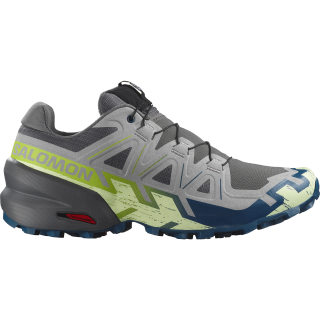 SalomonSPEEDCROSS 6 Castlerock/Lime Cream/Poseidonfrom150,00 €in stock
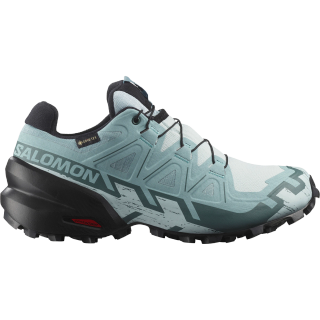 SalomonSPEEDCROSS 6 GTX W Ballad Blue/Black/Tourmalinefrom170,00 €low stock
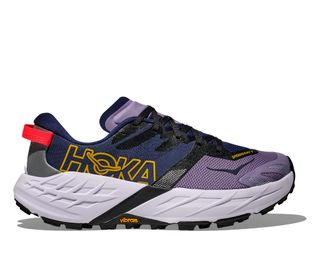 HokaW Speedgoat 7 Berry JAM / Starlight Glowfrom165,00 €low stock
A note on the Speedcross: the long lugs are less pleasant on tarmac and hard gravel. If you run a few kilometres on the road to reach the trail, you'll notice it.
What helps on roots, rocks and wet stone?
On wet rock and slate, lug depth matters less than the rubber compound and a large contact area. On sharp stones, a rock plate in the sole helps by absorbing pressure points under the foot. Good heel hold gives you security when your foot slides off a root.
The Brooks Ghost Trail has a TrailTack rubber outsole for grip on wet and dry surfaces and a rock plate in the forefoot against sharp stones. The LOWA Amplux 2 GTX was developed further with the LOWA Trail Racers Team: a midsole of two EVA densities and a carbon-reinforced shank are meant to combine cushioning with a smooth roll, and a GORE-TEX membrane keeps the rain out. The ASICS Trabuco 14 GTX for women offers a grippy outsole, GORE-TEX and extra stability for longer runs off-road.
For rocks and roots
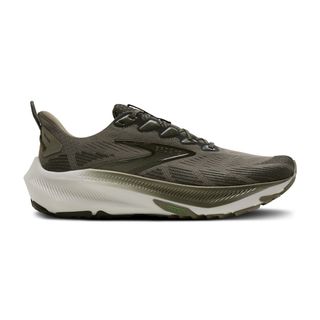 BrooksGhost Trail Olive/Olive/Metallicfrom150,00 €in stock
 LOAMPLUX 2 GTX schwarz/olivfrom170,00 €low stock
 AsicsTRABUCO 14 GTX Rotfrom170,00 €in stock
Even the best rubber slips on wet, sloping rock and on wooden boardwalks. There, the only thing that helps is running more slowly with short steps.
What if you mainly run on forest tracks?
Many Eifel loops follow wide forest and farm tracks with firm gravel and only short stretches of narrow path. For these, a shoe with a medium tread that also feels good on tarmac on the way to the woods is enough. According to Brooks, the Brooks Divide 6 GTX is built for exactly this transition: DNA Loft v2 cushioning, grippy lugs for unsurfaced paths and GORE-TEX Invisible Fit against the wet. The Brooks Divide 6 GTX for women has a TrailTack outsole for wet and dry ground and a flexible forefoot.
For road and forest track
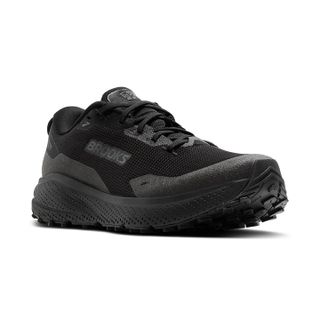 BrooksDivide 6 GTX Black/Black/Ebonyfrom130,00 €in stock
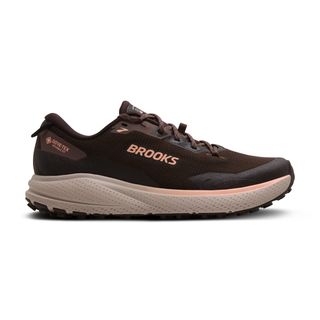 BrooksDivide 6 GTX Coffee Bean/Peppercorn/Rosefrom130,00 €in stock
How to choose the shoe for your foot, whatever the surface, is covered in Which running shoes are right for me?. If you'd rather hike the Eifelsteig than run it, you'll find pointers in Eifelsteig: boots and jacket.
How should a trail shoe fit?
Off-road, your foot has to sit more firmly in the shoe than on the road. If it slides back and forth on a path that slopes sideways, even the best tread is of little use. The midfoot should be well held and the heel must not lift. At the front you still need about 0.5 to 1 cm of room so your toes don't hit the end on descents. Tuck away laces and the ends of quick-lace systems such as Salomon's Quicklace so they don't catch on branches and brambles.
With or without GORE-TEX?
A waterproof membrane keeps your feet dry and warm for longer in rain, slush and puddles. In the Eifel, that's a real advantage from October to April. The drawback: if water runs into the shoe over the top of the collar, for example when you wade through a stream or ankle-deep mud, it stays inside, and the shoe dries more slowly.
- With a membrane: cold, wet months, puddles and slush, short to medium loops.
- Without a membrane: warm months, stream crossings, very deep mud, when fast drying matters more.
- If you buy only one pair and run in the Eifel all year round, you'll usually be happier with a membrane.
In winter it's also worth getting the clothing right: Winter running: what to wear. And because it gets dark early on forest tracks: Running in the dark: how to stay visible.
Checklist: trail running shoes for the Eifel
- Assess the surface of your loops: mud, rock or forest track.
- For mud: long lugs with wide spacing.
- For rocks: a grippy rubber compound and a rock plate.
- For mixed loops: a medium tread that also copes with tarmac.
- GORE-TEX for the wet months, no membrane for stream crossings and summer.
- Try trail shoes on with the socks you run off-road in.
- After a run, brush off the mud and dry the shoes at room temperature.