
Eifelsteig: which hiking boots and which jacket for the stages?
The Eifelsteig has 15 stages of 15–28 km. Which hiking boots, rain jacket and socks cope with rock, forest floor and wet meadows on the trail.
By Sport Giese Redaktion ·

For the Eifelsteig you need an ankle-high hiking boot or a sturdy low-cut hiking shoe with a grippy rubber sole and a waterproof membrane, plus a light waterproof jacket with taped seams. The stages are 15 to 28 km long and cross rock, roots and wet meadows. A running shoe or a casual trainer is not enough.
How hard is the Eifelsteig?
The Eifelsteig is a 313 km long-distance trail from Aachen-Kornelimünster to Trier, divided into 15 day stages. The operator rates it as moderate and expects a good basic level of fitness. Stages range from 15 to 28 km, and the trail is waymarked in both directions.
Three examples from eifelsteig.de show how much the stages differ:
- Stage 3, Monschau–Einruhr: 24.3 km, 786 m of ascent and 903 m of descent, rated difficult. The trail climbs and drops constantly, partly on rocky paths, and the high ground near Höfen can be windy.
- Stage 9, Hillesheim–Gerolstein: 22.4 km, 361 m of ascent and 420 m of descent, rated moderate, with forest tracks, open countryside and a steep path down into the valley.
- Stage 14, Bruch–Kordel: at 27.8 km the longest stage, 507 m of ascent, rated difficult. Since 2021 a destroyed bridge means it can only be walked as far as the Deimlinger Mühle, which makes it about 5 km shorter.
For your gear this means: you will be on your feet for six to eight hours, often on unsurfaced ground, and the weather can change within a single stage. Before every hike, check eifelsteig.de for current diversions.
Which hiking boots are right for the Eifelsteig?
For full stages, a boot with a firm upper, a torsionally stiff sole and deep lugs is the safe choice. On long descents over rock and wet roots it keeps your foot stable, and the membrane keeps out the wet grass in the morning. If you only walk short sections and are sure-footed, a more flexible low-cut shoe will do.
According to LOWA, the LOWA Renegade EVO GTX Mid is one of the brand's most popular boots; the EVO version focuses on fit and room for the toes. The Meindl Ohio 2 GTX is a light hiker with a nubuck upper, a GORE-TEX lining and the Magic Light Trail sole. Lighter and sportier is the Salomon X Ultra 360 GTX, with a Contagrip outsole, a reinforced toe cap and the ADV-C Chassis for stability on uneven ground; for women there is the X Ultra 360 GTX W.
Hiking boots for full stages
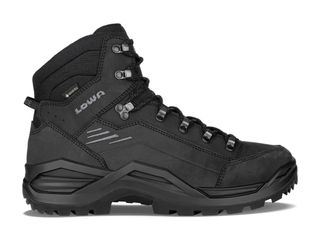 LORenegade EVO GTX MID Tiefschwarzfrom230,00 €low stock
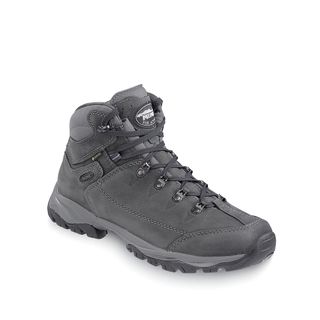 MeindlOhio 2 GTX anthrazitfrom229,90 €low stock
 SalomonX ULTRA 360 GTX Blue Nights/Dark Navy/Dark Bluefrom145,00 €low stock
 SalomonX ULTRA 360 GTX W Sedona Sage/Black/Sea Foamfrom145,00 €low stock
Whether you need a membrane depends on the season and the weather. The pros and cons are explained in Waterproof hiking boots: membrane, tread and when they are worth it.
Low-cut shoe or ankle-high boot?
Ankle-high boots give support on loose stones and protect your ankles from rocks and branches. Low-cut shoes are lighter and more agile, but they are less forgiving once you get tired. For several stages in a row with a backpack we recommend ankle-high boots; for single day stages with a light load, a low-cut shoe is enough.
Fit matters more than the height of the upper. A boot that pinches after 20 km does you no good, however much it can do on paper. Try hiking boots on in the afternoon, wearing the socks you will hike in. In Bitburg or Prüm you can compare several models side by side. How to prepare new boots before your first stage is covered in Breaking in new hiking boots and lacing them properly.
Which jacket do you need on the Eifelsteig?
You need a waterproof jacket with taped or welded seams and an adjustable hood. On the high plateau of the Eifel, rain and wind often arrive together; a jacket that is merely water-repellent will be soaked after an hour of steady rain.
The CMP men's jacket with fixed hood is a two-layer shell with a Clima Protect membrane, fully taped seams, waterproof zips on the side pockets and Velcro (hook-and-loop) cuffs. For women, the CMP Snaps Hood jacket is a lighter option: it comes down over the hips, has sealed seams, CMP states Waterproof 10,000 and MVP 4,000, and it packs into its own side pocket. If the jacket spends most of the day in your backpack, take the Dare 2b Pack It Jacket III: unlined, with welded seams and a stuff sack.
Weather protection for the stage
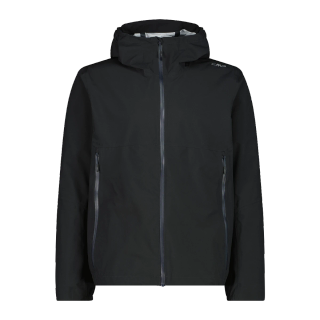 CMPMAN Jacket FIX Hood Antracitefrom99,95 €low stock
 CMPWoman Jacket Snaps Hood Terrafrom79,95 €low stock
 Dare 2bPack It Jkt III Oxford Bluefrom80,00 €low stock
What the figures in millimetres and grams mean is explained in Rain jackets for hiking: hydrostatic head and breathability. Under the jacket, several thin layers work better than one thick sweatshirt: the outer layer protects, the middle layer insulates and the inner layer moves sweat away from your skin.
What else goes in the backpack besides boots and jacket?
On long stages, socks make a real difference. Good hiking socks are padded at the heel and the ball of the foot and have no thick seams over the toes. The Areco Eifel merino trekking sock comes in sizes 36 to 47. For a day stage a daypack of about 20 litres is enough, for example the Salomon Aerotrek 20 with a breathable back system and storage pockets.
Gear in this guide
 ArecoTrekkingsocke Eifel Merino anthrazitfrom24,99 €in stock
 SalomonAerotrek 20 Sedona SAGE/SEAGRASS/Nine Ironfrom150,00 €low stock
The full list with water, food and small items is in Day hike in the Eifel: backpack checklist.
Checklist for your first Eifelsteig stage
- Check the stage on eifelsteig.de: length, elevation gain, diversions, getting there and back by bus or train.
- Boots broken in on at least two or three shorter hikes beforehand.
- Waterproof jacket with hood in the backpack, even if the morning is sunny.
- A warm layer for breaks, because you cool down quickly in damp clothing.
- A second pair of socks in a bag.
- First-aid kit, a phone with a charged battery and a map or a map app with offline data.
- In autumn and winter: a head torch (headlamp), because it gets dark early, and gloves.