
Breaking in new hiking boots and lacing them properly
How to break in new hiking boots step by step and lace them for climbs and descents: heel lock, relieving pressure points and the right socks.
By Sport Giese Redaktion ·

You break in new hiking boots by first wearing them in everyday life for a few days, then on short walks of one to two hours, and only after that on a full day hike. Modern hiking boots made of fabric or suede often need only a few days for this; stiff leather boots take longer. Lacing matters at least as much: it holds your heel in place and stops your foot sliding forward on descents.
Do hiking boots still need breaking in today?
Yes, but for less time than they used to. Light boots made of mesh, suede and microfibre are usually soft when you buy them. What still has to adapt is the footbed and the padding: they mould to your foot after a few hours. And you get to know the boot, where it holds firmly and where the lacing needs tightening.
Sturdy leather boots with a stiff sole need more time. The leather gives at the flex points, and the sole becomes a little more supple with every kilometre.
How do I break in new hiking boots step by step?
- Days 1 to 3: wear the boots at home and on short errands, with the socks you plan to hike in.
- First week: go on a walk of one to two hours once or twice, ideally with a few climbs.
- Second week: a half-day hike carrying a backpack loaded the way you will carry it later.
- After that: your first full hike. For the Eifelsteig, with stages of 15 to 28 km, the boots should already have several hikes behind them.
On every walk, pay attention to where your feet get warm or something rubs. A warm spot is a sign that the lacing or the sock is not right there. If a spot keeps pressing after several walks, it is usually the fit, not a lack of breaking in. If foot pain persists, have it checked by a doctor.
How do I lace hiking boots properly?
A hiking boot has three zones that you can lace with different tension: the forefoot, the instep and the cuff around the ankle. Many boots have a locking hook or a lace guide between them that holds the tension.
- Forefoot: rather loose, so that the toes have room and can move as the foot rolls.
- Instep: firm enough that the foot does not slide forward. This is the most important zone.
- Cuff: a little looser on climbs so the ankle stays mobile, firmer on descents.
Some manufacturers solve this with their own systems. On the Meindl Top Trail Lady GTX, the variofix system with a free-running Speedwire pulls the heel in evenly, and the lacing extends far forward so it can adapt to the foot without pressure points. The Salomon X Ultra 360 GTX W has Quicklace speed lacing, and the adidas Terrex Skychaser a Speed Lacing System for a secure fit. The LOWA Ventierra GTX LO has flexible lacing in the forefoot area and a soft collar.
Hiking boots with well-designed lacing
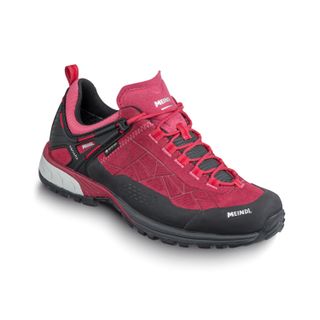 MeindlTop Trail Lady GTX rubinrotfrom199,90 €low stock
 SalomonX ULTRA 360 GTX W Sedona Sage/Black/Sea Foamfrom145,00 €low stock
 AdidasTerrex Skychaser Olistr/gretwo/cblackfrom140,00 €low stock
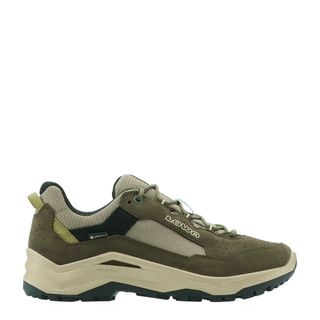 LOVENTIERRA GTX LO oliv/bernsteingrünfrom160,00 €low stock
Which lacing techniques help with common problems?
Heel slip: the heel lock
If your heel lifts as you walk, use the top eyelet to make a loop. On each side, thread the lace from the outside into the top eyelet so that a small loop forms. Then pass the opposite end through each loop and pull both down and outwards. The lacing now draws the cuff back against your heel. This is also known as a heel lock or runner's loop.
Pressure on the instep: skip an eyelet
If the lacing presses on one spot on top of your foot, skip a pair of eyelets there and run the lace straight up on the same side to the next eyelet. This creates a pressure-free window over the sensitive spot, often called window lacing.
Toes hitting the front on descents: tighten the instep
If your toes hit the front of the boot going downhill, lace the instep and cuff tighter before the descent. If that is not enough, the boot may be too short. There should be about a thumb's width of room at the front.
Which socks and laces work best?
When breaking in boots, socks matter as much as the boot. Always walk in the socks you will wear on the trail. Good hiking socks are padded at the heel and the ball of the foot and have no thick seam over the toes. The Areco Eifel merino trekking sock comes in sizes from 36–38 to 45–47.
A frayed lace usually snaps just when you pull it tighter on a hike. Replacement laces for hiking boots come round, such as the leazy round laces for 6 eyelets, or as leazy round laces in black in several lengths. Round laces slide more easily through hooks and guides; flat ones lie more quietly on the instep.
Gear in this guide
 ArecoTrekkingsocke Eifel Merino anthrazitfrom24,99 €in stock
 leazySchnürs. rund L d.grau 6Ösen Sonstige Hauptfarbefrom9,95 €low stock
 leazySchnürsenkel ROUND schwarz Sonstige Hauptfarbefrom12,99 €low stock
If you tend to use insoles: the fit of a hiking boot depends heavily on the footbed. Our free 3D foot scan helps you choose the boot and the insole; more on that in 3D foot scan.
What if the new boot still does not fit after breaking it in?
If a boot keeps pressing on the same spot after three or four walks, it will usually not change any more. Better to rethink now than on your first big hike. Next time you buy, try hiking boots on in the afternoon, when your feet are slightly larger, and test on a sloping surface whether your toes hit the front going downhill. What else makes a good hiking boot for the Eifel is covered in Eifelsteig: which boots and which jacket.