
Shin pads: size, fastening and why they are compulsory
Shin pads (shin guards) are compulsory under Law 4 and must be covered by the socks. Which size, which fastening, and what the football (soccer) rules require.
By Sport Giese Redaktion ·

Yes, shin pads (shin guards in the US) are compulsory in football (soccer). Law 4 of the Laws of the Game lists them as compulsory equipment: they must be made of a suitable material, provide reasonable protection and be covered by the socks. Since the 2024/25 season, the law has also stated explicitly that every player is responsible for the size and suitability of their own shin pads.
For parents, that means the pad must fit the child's leg, go under the socks and stay in place until the final whistle. This guide explains what the rule requires, how to find the right size and which fastening suits whom.
What exactly does the rule say?
Under Law 4, a player's compulsory equipment consists of a shirt with sleeves, shorts, socks, shin pads and footwear. The rulebook of the DFB (the German Football Association) states that shin pads must be made of a suitable material that provides reasonable protection and must be covered by the socks. The IFAB, which sets the Laws of the Game worldwide, adds that they must be of an appropriate size and that players are responsible for their size and suitability.
The rule applies to adult and youth football alike. For indoor football, the regional associations include it in their own regulations; the Südwestdeutscher Fußballverband (the regional football association for our area), for example, explicitly lists shin pads as compulsory in its simplified futsal rules for under-11 and under-13 teams. For tournaments, the rules of the individual event apply as well.
What size shin pads do I need?
A shin pad is the right size when it reaches from the ankle to just below the knee and covers the shin. This rule of thumb comes from teamwear retailers; it is a practical guide, not a requirement of the IFAB laws, which only ask for an appropriate size. Measure the length of the shin from the ankle to just below the knee and compare it with the brand's size chart.
- Brands size their pads differently: some by the wearer's height, others by shin length. The size chart on the product page is what counts.
- If the pad sticks out at the edges or wobbles when you move, it is too big.
- It must fit completely under the socks, otherwise it does not comply with the rule.
- For children, try pads on again at the start of every season; last year's pad is often too short.
Which fastening suits whom?
There are basically two designs: slip-in pads, usually held by an elastic sleeve, and pads with ankle protection that sit on the leg with straps or Velcro (hook-and-loop). Pads with ankle protection sit more firmly on the leg; slip-in pads are lighter and quicker to put on.
Slip-in pads with a sleeve
Many older players prefer slip-in pads because they want freedom of movement at the ankle. The Erima Flex Guard has a flexible, impact-resistant TPU shield with breathable EVA foam and is held in place by the tube socks that come with it. The Jako River Light is a light slip-in pad with an ergonomically shaped hard shell, EVA padding and an elastic sleeve.
Slip-in pads
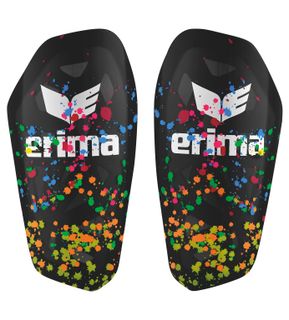 ErimaFlex Guard blackfrom29,99 €in stock
 JakoSchienbeinschoner River Light Blaufrom19,99 €low stock
When does a shin pad with ankle protection make sense?
A shin pad with ankle protection makes sense for younger children and for anyone whose pads slip when running. It sits more firmly on the leg than a slip-in model, thanks to straps or Velcro. The Jako River Classic has a light hard shell with fixed ankle protection and an adjustable Velcro strap. The Erima Flex Guard Ergono has a light polyethylene shield, fixed ankle protection and anatomically placed Velcro straps.
With ankle protection
 JakoSchienbeinschoner River Classi lightblue/blau/JAKO blaufrom17,99 €low stock
 ErimaFlex Guard Ergono Braunfrom17,99 €in stock
What can I do if my shin pads keep slipping?
A slipping shin pad can usually be fixed with a new sleeve, a shin pad strap or a sock tie. The sleeve of a slip-in pad stretches out over time. The Jako replacement sleeve for shin pads, made of elastic polyester-elastane, comes in several sizes. The Jako shin pad strap is a 6.5 cm wide elastic band with Velcro that holds the pad on the leg. The narrower Jako sock tie, 25 mm wide, keeps the socks up. Choose a colour that matches the socks if the band shows on the outside.
So nothing slips
 JakoErsatzstrumpf Schienbeinschone Blaufrom6,99 €in stock
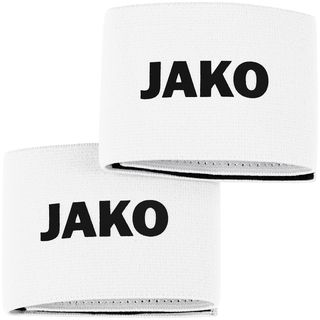 JakoSchienbeinschonerhalter weissfrom9,99 €low stock
 JakoStutzenhalter weissfrom7,99 €low stock
Which shin pads fit small children?
For Bambini (under-7s) and F-Jugend players (under-9s), shin pads come in the smallest sizes, usually labelled XXS or XS. Here too, the pad must cover the shin and fit completely under the socks; a pad that is too long gets in the way when running. For small children, models with ankle protection and Velcro are a good choice, because the pad stays in place without a sleeve and, with a little practice, the child can put it on alone. Try the pad on with the football socks your child wears for training, and check the fit again at the start of each half-season or indoor season.
How do I look after shin pads?
Take the pads out of the bag after every training session and let them air-dry. According to Erima, plastic shells like those of the Erima Flex Guard are easy to wipe clean. Wash sleeves and straps like sportswear. Left damp in the bag, shin pads quickly start to smell. What else goes in the bag is listed in the football bag checklist; for indoor football, see also indoor football shoes for kids.
Checklist before the match
- The pad reaches from the ankle to just below the knee and lies flat.
- Completely covered by the socks.
- Visible tape or sock ties in the colour of the socks.
- Jewellery taken off, not taped over.
- A spare sleeve or strap in the bag in case something slips.