
Indoor football shoes for kids: sole, size and sports hall rules
Which indoor shoes do kids need for winter football (soccer)? Non-marking sole, Velcro or laces, about 12 mm of room, and what sports hall rules require.
By Sport Giese Redaktion ·

For indoor football (soccer), children need shoes with a flat, non-marking rubber sole, labelled IN, IC or IT. As a guide value, the inside of the shoe should be about 12 mm longer than the foot, and the shoes should be worn only indoors. Moulded or screw-in studs are not allowed in sports halls.
From November, many youth teams move indoors. Parents then wonder whether the trainers from school PE will do or whether their child needs proper indoor football shoes. This guide explains what matters about the sole, the fastening and the size.
What do sports hall rules require of shoes?
The hall rules of German towns and municipalities often require sports shoes with soles that leave no marks on the floor. Karlsruhe requires trainers with non-marking soles. Dortmund bans street shoes, studded and rubber-studded shoes, and shoes without abrasion-resistant soles. In Balve, trainers that are also worn outdoors may not be used in the hall (all rules in German).
For your child, that means one pair worn only indoors, straight out of the bag. The coach or the club knows which rules apply in your sports hall (gym). The house rules are usually posted at the entrance.
How do I recognise a good indoor sole?
A good indoor sole is flat, made of rubber, abrasion-resistant and labelled as non-marking. The name includes IN (adidas), IC (Nike) or IT (PUMA). PUMA describes indoor soles as made for grip and comfort on hard surfaces. A fine tread pattern helps with quick changes of direction on a smooth floor.
For older children who tie their own laces, classic indoor football shoes fit the bill. According to adidas, the rubber outsole of the adidas F50 Hyperfast Club IN J grips flat indoor floors and does not mark. The adidas Super Sala III J has an abrasion-resistant, non-marking rubber outsole and a padded mesh tongue. The adidas Predator Club IN Sala J combines mesh with TPU reinforcements, also with a non-marking sole. The PUMA Ultra 7 Play IT Jr has an abrasion-resistant rubber sole with a fine, multidirectional tread and a pull tab at the heel.
Lace-up indoor shoes
 AdidasF50 Hyperfast Club IN J Pulmin/ntnavy/sollemfrom50,00 €in stock
 AdidasSuper Sala III J Lucblu/ftwwht/luclemfrom45,00 €low stock
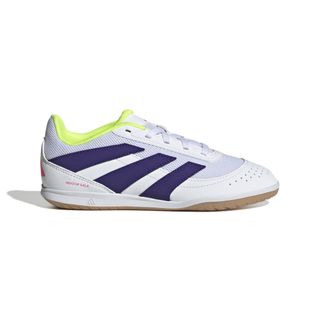 AdidasPredator Club IN Sala J Ftwwht/cpurpl/luclemfrom50,00 €low stock
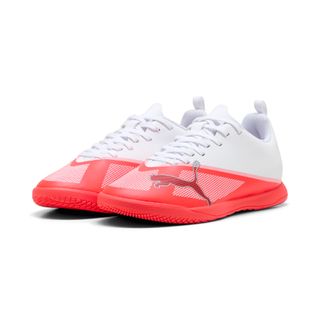 PumaUltra 7 Play IT Jr Ultra Red-PUMA Black-PUMA Whitefrom44,95 €in stock
Velcro or laces?
For children who cannot tie a bow yet, a Velcro (hook-and-loop) fastening is the practical choice. It is quicker in the changing room, and no loose lace interrupts training. Once your child ties laces confidently, laces are worth it because they let you adjust the fit more precisely.
On the Nike Jr. Mercurial Vapor 16 Club IC for younger children, a Velcro strap holds the shoe, so nobody has to tie anything. The adidas F50 Messi League IN has no laces and closes with Velcro; its rubber outsole is made for flat indoor floors. The Newline Top Star I.C. VC 2.0 JR combines elastic laces with an adjustable Velcro strap.
Indoor shoes with Velcro
 NikeJR Vapor 16 Club IC PS (V) Gelbfrom39,99 €low stock
 AdidasF50 Messi League LL IN IVORY/SEBLBU/ICEBLUfrom75,00 €low stock
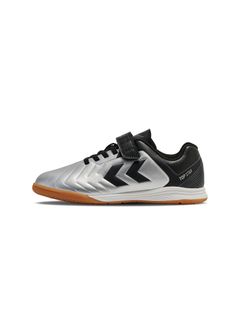 NewlineTOP Star I.c. VC 2.0 JR Black/silverfrom39,95 €low stock
A note on Nike IC shoes: Nike says they also suit streets and hard courts. If your child wears them outdoors, they still need a clean pair for the hall, otherwise the sole carries sand and dirt onto the sports hall floor.
What size should kids' indoor shoes be?
As a guide value, the inside of the shoe should be at least 12 mm longer than the longest toe; recommendations vary with the type of shoe and the measuring method. This figure comes from children's shoe expert Wieland Kinz in Apotheken Umschau, a German health magazine. The same article recommends checking every two to three months whether the shoe still fits. In practice: take out the insole and have your child stand on it, then check heel hold and width with the foot inside the shoe.
Nike advises measuring children's feet in the evening and with football socks, because thick sports socks take up room. Sometimes that means half a size more. An indoor shoe must not be too big, though: if the heel slips out when walking, the foot lacks support in quick turns. How to work out the room to grow precisely is explained in football boots for kids: the right size.
Nike labels children's sizes in US sizes with C (younger children) or Y (older children); adidas and PUMA use EU or UK sizes. Do not rely on the number from the last pair; go by the measured foot length and the brand's size chart. If you are unsure, the best option is to try shoes on in Bitburg or Prüm, with the socks your child wears for training.
Does my child need shin pads indoors?
Yes, in organised matches they usually do. Under Law 4 of the IFAB (the body that sets the Laws of the Game), shin pads (shin guards) are compulsory equipment, and the regional associations apply this to indoor football. The Südwestdeutscher Fußballverband (the regional football association for our area), for example, explicitly lists them as compulsory in its simplified futsal rules for under-11 and under-13 teams. For indoor tournaments, the rules of the individual event apply. Size and fastening are explained in shin pads: size, fastening and the rules.
If your child also needs indoor shoes for school PE or handball, the differences between soles are covered in indoor court shoes for fitness, badminton and handball.
What else goes in the bag for indoor training?
Besides the indoor shoes, the bag should hold shin pads, football socks, a water bottle and a bag for the outdoor shoes. In winter many children come straight from school, so a warm jacket for the way home is worth packing when it is dark and cold outside. Keep the indoor shoes in a separate compartment or bag so that no sand from the outdoor pitch gets onto the sole. The full list for training and matches is in the football bag checklist.
Checklist for buying
- Flat rubber sole, labelled non-marking; code IN, IC or IT.
- No moulded studs, no screw-in studs, no shoes that are also worn outdoors.
- Measure foot length in the evening with football socks; guide value about 12 mm of room in front of the longest toe; check heel hold and width.
- Velcro for children who cannot tie laces yet; laces for a more precise fit.
- Measure again every two to three months.
- Do not forget shin pads and a water bottle.