
Goalkeeper gloves: grip, cut and size for kids and adults
Negative cut, roll finger or regular cut? How latex, cut and size work together, which goalkeeper gloves suit beginners and kids, and how to care for them.
By Sport Giese Redaktion ·

A good goalkeeper glove (goalie glove in the US) fits snugly without pressing, has a latex palm for grip and a cut that suits the player. Beginners and children do well with a hard-wearing glove in the classic regular cut; experienced goalkeepers often choose a negative cut for a close fit or a roll finger for a large catching area. Care matters at least as much as the model, because latex suffers without it.
What gives a goalkeeper glove its grip?
The grip comes from the latex foam palm. Brands offer different compounds: Reusch describes its Grip Gold X palm as latex infused with adhesive particles, its Grip range as the basis of all Reusch palms, and Solid Grip and Resist Grip as a good choice for beginners and young goalkeepers. In the River range, Jako uses German quality latex foam.
A grippy palm does not work on its own: it needs to be clean and slightly damp. Many brands, Reusch among them, recommend moistening the gloves slightly before the game; follow the care instructions for the model. A second, tougher pair for training on artificial grass spares the match pair.
Which glove cut suits me?
The cut decides how closely the glove fits and how large the catching area is. These are the four common cuts as Reusch describes them:
- Regular cut or flat cut: a flat palm with external seams, at Reusch for example the Expanse Cut. The classic cut found on many beginner models.
- Negative cut: back of the hand and palm are stitched on the inside, with gussets between the fingers. This gives a close fit and a lot of feel for the ball.
- Roll finger: the latex is rolled seamlessly around the fingers, giving the largest possible catching area.
- Hybrid: negative stitching with only one gusset, and the latex rolled around the index and little finger, a mix of both. One variant is the Evolution Negative Cut, where the latex is rolled around the fingertips.
There is no rule as to which cut is "better". If you have slim hands and like to feel the ball closely, you will usually be comfortable in a negative cut. If you prefer less tightness in the fingers, try a regular cut or roll finger instead. It is best to try two cuts on one after the other.
Which goalkeeper gloves are good for kids and beginners?
For children and beginners, a hard-wearing glove in a regular cut with a Velcro (hook-and-loop) wrist strap that is easy to put on is a good choice. The Jako River Basic RC Protection has a palm made of German latex foam, a regular cut, the 360° closure system and finger reinforcement (V-Finger Protection); Jako calls it ideal for beginners and recreational keepers, and it is available from small children's sizes upwards. The Jako River Basic RC is the model without the Protection add-on, with a latex palm and breathable inserts.
For beginners and kids
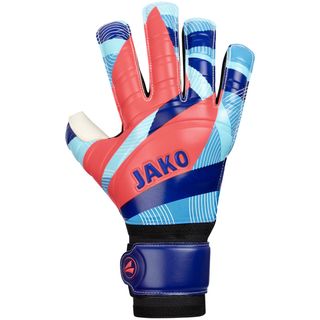 JakoTW-Handschuh River Basic RC Pr navy/skyblue/coralfrom39,99 €low stock
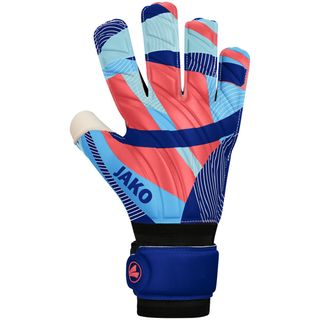 JakoTW-Handschuh River Basic RC navy/skyblue/coralfrom34,99 €low stock
Gloves with finger protection are stiffer. Whether a child wants to play in them is a matter of feel; it is best to discuss this with the goalkeeping coach.
Which gloves for ambitious goalkeepers?
If you play in goal regularly, you will usually choose a closer-fitting glove with softer latex. The Reusch Attrakt RE:GRIP NC combines two layers of latex so that the grip surface stays usable for longer, and fits closely thanks to its negative cut. The Reusch Legacy Arrow Pro Am Silver has the soft, high-volume Grip Silver latex compound, an Evolution Negative Cut and the classic strap closure. On the adidas Predator Competition, a URG 2.0 latex palm and a negative cut on the fingers provide a precise fit. The Reusch Attrakt Gold X NC has the Grip Gold X palm, which Reusch describes as latex with adhesive particles.
For matches and club football
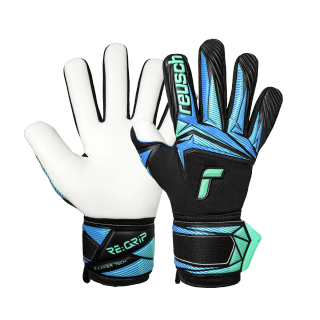 Reusch5670535 Attrakt Re:grip NC 7275Black/ocean lightfrom70,00 €low stock
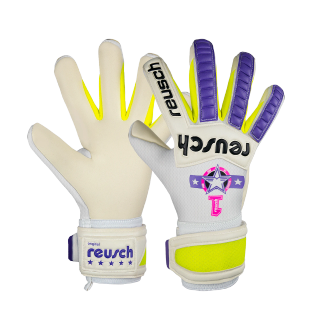 ReuschReusch Legacy Pro Am Silver Weißfrom69,95 €low stock
 AdidasPred GL COM Lucred/black/whitefrom110,00 €low stock
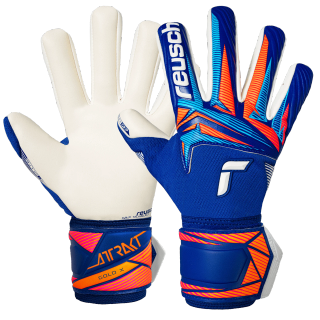 ReuschAttrakt Gold X NC Sonstige Hauptfarbefrom80,00 €low stock
What size goalkeeper gloves do I need?
Goalkeeper gloves come in numbered sizes from about 4 for small children's hands to 11 or 12 for large adult hands. Brands measure differently: some by the circumference of the hand, others by its width. So use the size chart of the individual brand and try gloves on if you can.
- The fingertips almost reach the end of the glove but do not touch it.
- When you make a fist, the glove does not pull tight over the knuckles.
- Because of the internal seams, a negative cut usually fits more tightly than a regular cut in the same size.
- Children's hands grow: better to try gloves on again every season than to buy two sizes up. Too much room in the fingers makes catching less secure.
How do I look after goalkeeper gloves properly?
Reusch sets out care rules that suit many latex gloves; if in doubt, the care instructions of the model take priority:
- Before first use, rinse the palm thoroughly with lukewarm water.
- Moisten slightly before the game, if the care instructions for the model say so.
- After every game, clean with warm water (35 °C at most), never in the washing machine and without harsh detergents.
- Let them dry slowly in the air, not on the radiator and not in the sun.
- Store in a cool, dry and dark place. UV light makes latex porous and brittle.
Checklist: the right goalkeeper glove
- Beginners and children: regular cut, hard-wearing palm, Velcro strap.
- Experienced goalkeepers: negative cut for a close fit, roll finger for a large catching area.
- Size from the brand's chart, fingertips almost at the end.
- A second pair for training spares the match pair.
- Moisten before the game as the care instructions say, rinse in lukewarm water afterwards, dry away from the heating.