
Caring for and reproofing hiking boots
How to clean, dry and reproof hiking boots properly: what leather and fabric need, what membrane boots cannot take and what boot care costs per season.
By Sport Giese Redaktion ·

Hiking boot care comes down to three steps: after the hike, clean them with lukewarm water and a brush, dry them slowly and away from the radiator, and renew the DWR (durable water repellent) treatment as soon as water stops beading off. Boots with GORE-TEX or another membrane do not belong in the washing machine and need a water-based waterproofing spray. With this routine the boot stays waterproof and breathable.
Why do waterproof boots need reproofing too?
The membrane sits on the inside as a lining. It keeps water out as long as the outer material is not soaked through. If leather or fabric soaks up water, the boot gets heavy and cold, and sweat can no longer escape. Your foot then feels wet even though the membrane is intact. The DWR treatment makes water bead up and roll off the outside. It wears off with every hike and has to be renewed.
How do I clean hiking boots properly?
For membrane boots, GORE-TEX recommends this order:
- Remove the laces, knock out sand and loose dirt, take out the insole and shake it out too.
- Clean the upper with a sponge or brush, lukewarm water and a little liquid detergent.
- For leather boots, follow the manufacturer's care instructions.
- No bleach, no stain remover, no washing machine.
Ideally, clean the boots straight after the hike while the mud is still soft. Dried Eifel clay is hard to remove and rubs against the material when you brush it. A soft brush is enough, even for the sole.
How do I dry wet hiking boots?
Slowly. GORE-TEX advises air-drying boots at a moderate temperature and avoiding direct heat sources. So do not put boots on the radiator, in front of the stove or under a hairdryer. But do not leave them standing wet for long either. According to GORE-TEX, boot dryers that work with natural air movement are suitable.
A proven method: take out the insole, open the lacing wide, stuff the boots with newspaper and replace it after a few hours. Then leave the boots in an airy place out of direct sunlight.
What care do leather and fabric need?
That depends on the upper material. Smooth leather and nubuck need, besides reproofing, an occasional conditioner that keeps them supple. Suede and fabric mainly need reproofing. The care instructions are usually in the shoe box or on the manufacturer's website; follow them.
For membrane boots, GORE-TEX explicitly recommends a water-based waterproofing spray rather than wax or grease, because these reduce breathability. That applies, for example, to the Meindl Ohio 2 GTX in nubuck, the Meindl Mondello GTX in suede and mesh, and the LOWA Innox Evo II GTX Ws in fabric and microfibre, all three with a GORE-TEX lining. It is different for a leather boot with a leather lining, such as the Meindl Borneo 2 MFS in waxed nubuck: here Meindl's care instructions determine which product is right.
Leather, suede and fabric
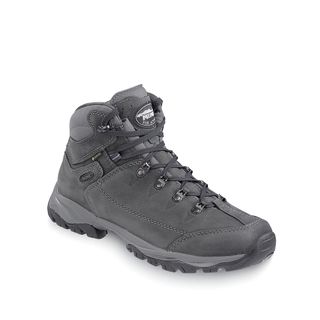 MeindlOhio 2 GTX anthrazitfrom229,90 €low stock
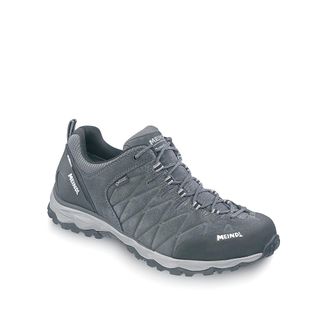 MeindlMondello GTX anthrazit/graphitfrom199,90 €low stock
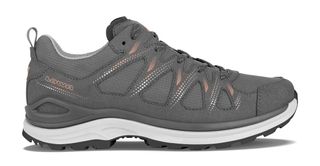 LOINNOX EVO II GTX Ws asphalt/lachsfrom170,00 €in stock
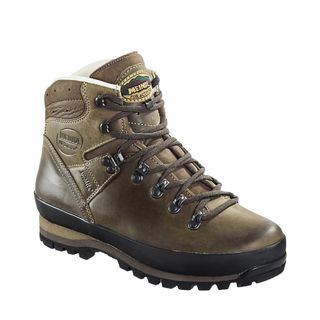 MeindlBorneo 2 MFS braun/nougatfrom269,90 €low stock
Whether a membrane makes sense for your hikes at all is explained in Waterproof hiking boots: membrane, tread and when they are worth it.
How often should I reproof my boots?
There is no fixed schedule. The test is how water behaves on the boot: if it beads up into drops, all is well. If it soaks in and the material turns dark, it is time. With regular hikes in the wet Eifel that is often the case after a few outings; on summer hikes on dry paths, less often.
- Clean the boot first; a DWR treatment will not hold on dirt.
- Apply the treatment while the boot is still slightly damp or dry, depending on the product's instructions.
- Spray outdoors and from a distance, evenly and without puddles.
- Leave to dry for several hours, ideally overnight.
What does boot care cost per season?
Little compared with the boot. A simple calculation with round example figures: a pair of hiking boots for €200 worn for five seasons costs €40 per season. Cleaning products and reproofing at €20 a year raise that to €60 per season.
The formula for your own numbers: cost per season = (purchase price ÷ number of seasons) + care products per year. How many seasons a boot lasts depends on your weight, the terrain, how often you hike and how you care for it, and cannot be promised. Only one thing is certain: a boot that is left wet in the corner after every hike ages faster than one that is cleaned and dried slowly.
Which small parts should I replace regularly?
Laces wear against hooks and eyelets and usually snap at the worst possible moment. Check them every time you clean the boots. Replacements are available, for example, as leazy flat laces in grey or leazy round laces in black in several lengths. Hiking socks also lose their padding at the heel and ball of the foot over time; the Areco Eifel merino trekking sock comes in sizes 36 to 47.
Gear in this guide
 leazySchnürsenkel FLAT d. grau Sonstige Hauptfarbefrom9,99 €low stock
 leazySchnürsenkel ROUND schwarz Sonstige Hauptfarbefrom12,99 €low stock
 ArecoTrekkingsocke Eifel Merino anthrazitfrom24,99 €in stock
If the sole is worn down or coming away, resoling by a cobbler is often worthwhile for high-quality leather boots. Ask the manufacturer whether your model is suitable. How to treat boots after a wet winter hike is also covered in Winter hiking in the Eifel.
Checklist: care after every hike
- Take out the laces and insoles.
- Knock off the dirt, clean with lukewarm water and a soft brush.
- Stuff with newspaper and air-dry away from the radiator.
- Water test: does it still bead off? If not, reproof.
- Give the laces, sole and seams a quick check.
- Store the boots dry, in an airy place and out of direct sun.